Home/Work/Transaction auto-review with human checkpoints
Case study · Real Brokerage · Real estate · 2024–26
Transaction auto-review with human checkpoints
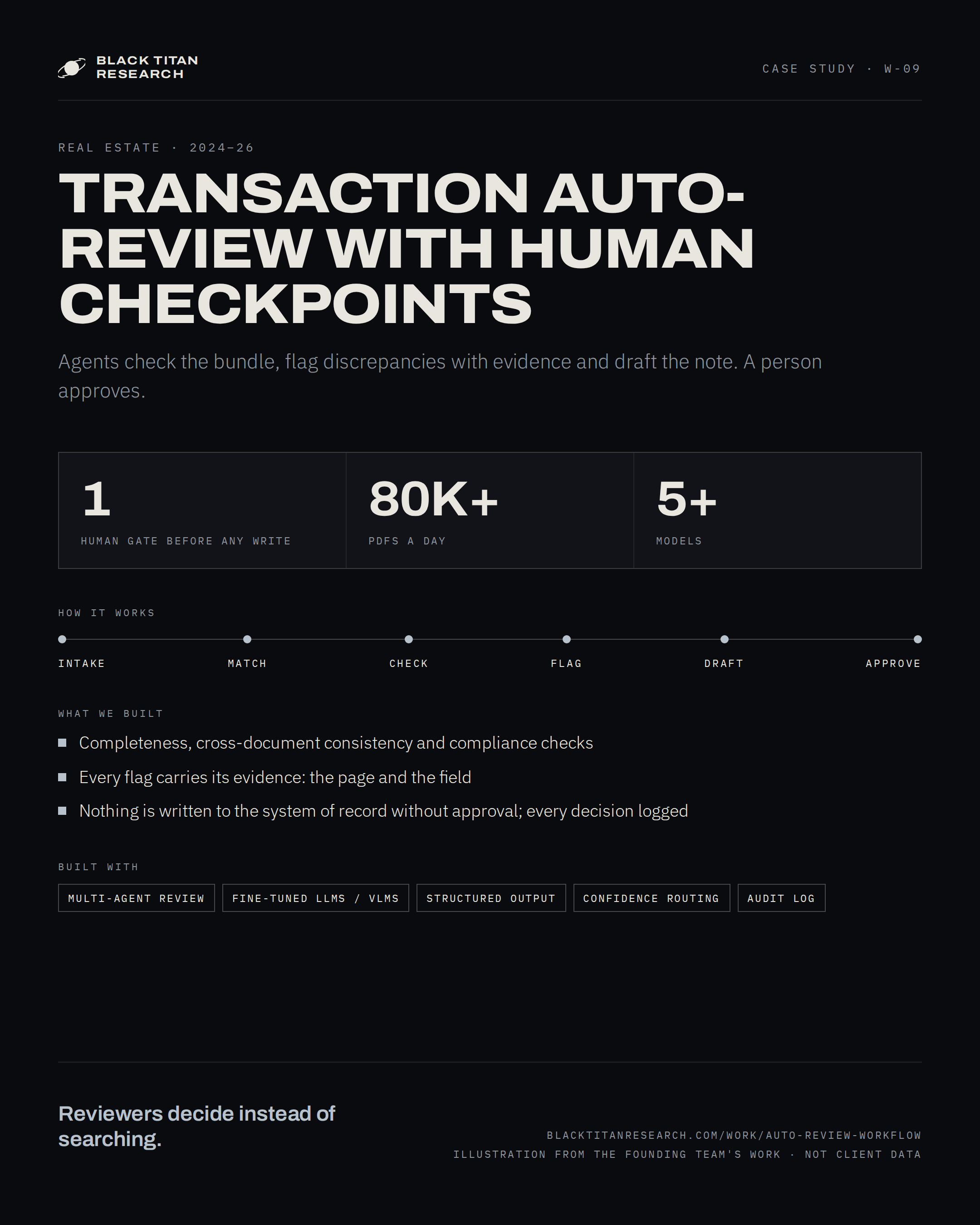
An agentic review workflow that checks every transaction bundle for completeness, consistency and compliance, drafts the reviewer's note with its evidence, and stops at a human gate. It sits on a platform that reads more than 80,000 PDFs a day.
- EmployerReal Brokerage
- RoleLead engineer
- Period2024 – 2026
- SectorReal estate brokerage
§ 01 — Problem
A real-estate transaction is a bundle of documents that must be complete, consistent with each other and compliant before it can close. Checking every bundle by hand made reviewers the bottleneck. Fully automatic approval was never acceptable for decisions with legal and financial weight.
The requirement was a review that does the mechanical work before a person opens the file, shows its evidence, and stops at a human gate. Nothing is written back to the system of record without that approval.
§ 02 — Architecture
Agents propose. A person decides.
Review is decomposed into cooperating agents coordinated through tool-calling, subagents and skills. Every proposal passes through one human gate before anything is written.
§ 03 — How it works
One transaction through review.
The animation follows a single transaction bundle through intake, matching, cross-document checks, flagging, drafting and the human decision.
Diagrams and films on this page are illustrations of the system's architecture and behaviour, drawn from my work at Real Brokerage. They are not screenshots or recordings of production systems, which remain confidential.
§ 04 — Approach
Agents
- Agents read the extracted record for each document. Records come from fine-tuned LLMs and VLMs tailored to real-estate documents, as structured output with per-field confidence.
- A completeness agent checks the bundle against what the transaction requires and flags what is missing.
- A consistency agent compares fields across documents and flags discrepancies with evidence: the page and field each value came from.
- A drafting agent writes the reviewer's note, then stops.
- Hosted Gemini 3.5 Pro/Flash and GPT-4o, fine-tuned for multi-LLM agentic workflows, coordinated through tool-calling, subagents and skills.
Controls
- One human gate: a reviewer approves, edits or rejects every proposal.
- Checks are implemented as validators developed per jurisdiction, because what a transaction requires differs from one jurisdiction to another.
- Nothing is written back to the system of record without that approval.
- Every proposal and decision is logged with its evidence and its approver.
- Low-confidence cases are routed to review rather than passed.
- Output is structured and auditable: schema-bound fields with a confidence on each.
§ 05 — Impact
Reviewers decide instead of searching. The mechanical part of review is done before a person opens the file: the bundle is checked for completeness, fields are compared across documents, and each discrepancy arrives with the page and field it came from. Every decision carries its evidence and its approver.
What generalises: agents that propose and stop are easier to trust than agents that act; evidence attached to every flag is what makes the human gate fast; and a log of every proposal and decision is what makes the workflow auditable.