Applied AI engineer & team lead who takes frontier research to production — RL post-training (GRPO) of SOTA LLMs & VLMs, multimodal pipelines fusing 5+ models, and architecture-level tuning for fast inference. Full stack: from model weights to Kubernetes.
I'm an AI engineer working across NLP, vision, and everything multimodal — at the intersection of deep-learning research and large-scale systems. I pretrain and fine-tune state-of-the-art LLMs and VLMs (LLaMA 3.3, Qwen 3, Gemma, Gemini 3.5 Pro, GPT-4o) using LoRA/QLoRA and RL post-training with GRPO to build reasoning and thinking capabilities into domain models.
Today I lead the development of an enterprise-scale, agentic AI document intelligence platform processing 80K+ PDFs a day — multi-agent text + visual reasoning that fuses 5+ specialized models (detection, OCR, VLMs, reasoning LLMs, embeddings) in a single microservices-based application, with tool-calling, subagents, and skills. Along the way I've built RAG systems, multi-LLM orchestration infrastructure, and extraction pipelines that took accuracy from 35% to 99.85%.
I also go below the framework line — tinkering with model architectures, quantization, and graph-level optimization to hit aggressive inference targets. Those instincts come from years of computer vision: real-time sports analytics, satellite segmentation, pose estimation, and edge deployment. I care about the whole stack, from a novel architecture to a quantized engine shipping 3× the FPS.
Multi-agent text and visual reasoning over unstructured real-estate documents: five specialised models coordinated by an orchestrator with tool-calling and subagents, open models fine-tuned with LoRA/QLoRA and GRPO, and a human queue for the low-confidence cases. In production.
Open models (LLaMA 3.3, Qwen 2.5 72B, Qwen 3, Gemma) fine-tuned with LoRA/QLoRA, then GRPO-post-trained with the task's verifier as the reward. Every adapter is evaluated against the hosted frontier on the task's own test set; winners are quantised and served on self-hosted GPUs, so the data stays in.
Detection, multi-object tracking, pose estimation and court localisation at full frame rate on a fixed GPU budget. Every stage profiled, dropped to FP16 or calibrated INT8, exported to ONNX, compiled to TensorRT and batched across streams. Offline analysis became real time.
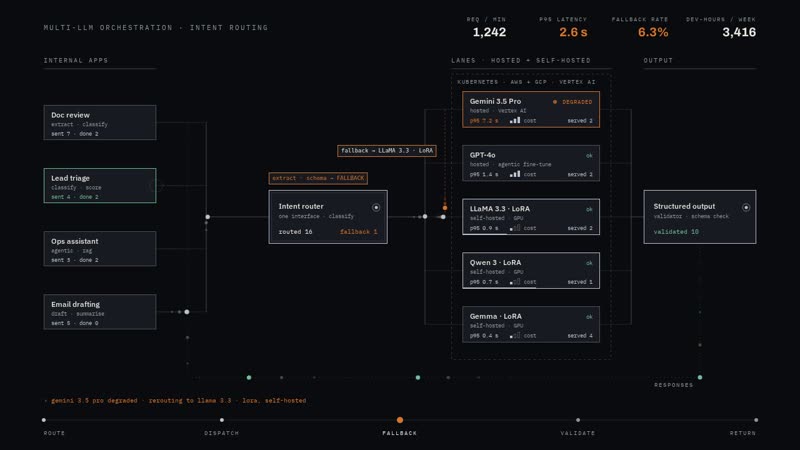
One interface over five model families, with intent routing, graceful fallback and shared evaluation.
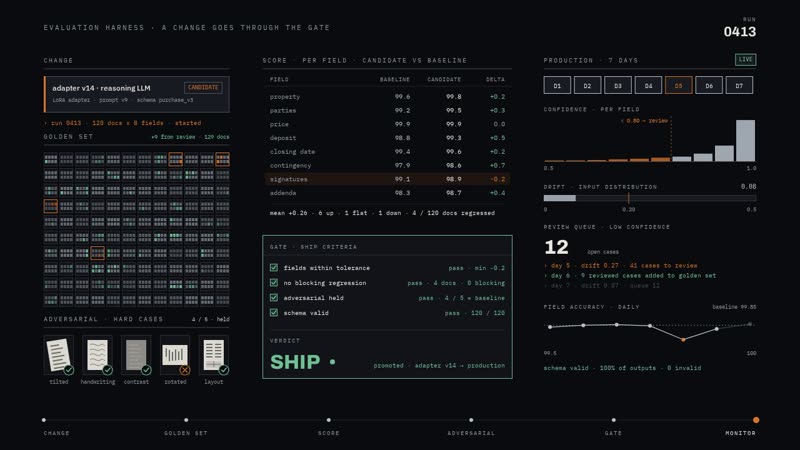
Golden sets, regression gates, adversarial cases and production drift monitoring. How we know it works.
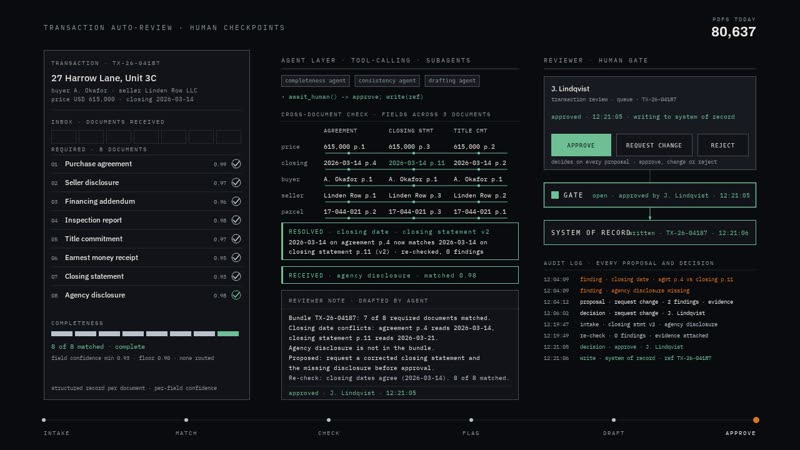
Agents check the bundle, flag discrepancies with the page and field as evidence, draft the note. A person approves.
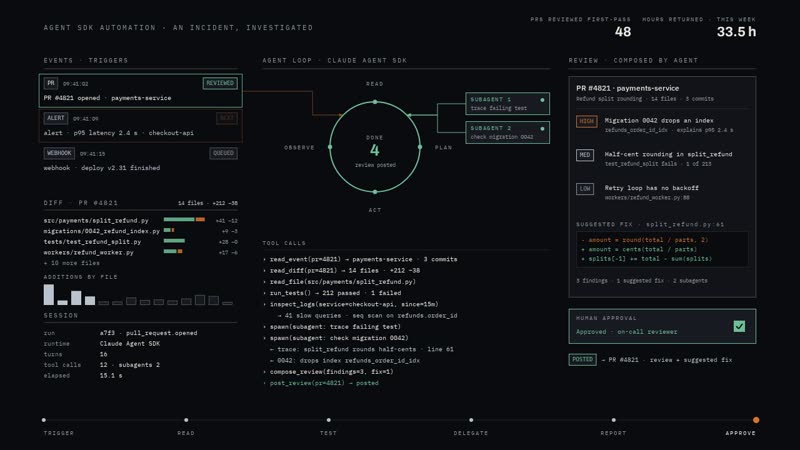
Triggered by pull requests, incidents and webhooks: reads the diff, runs the tests, inspects logs, delegates, reports.
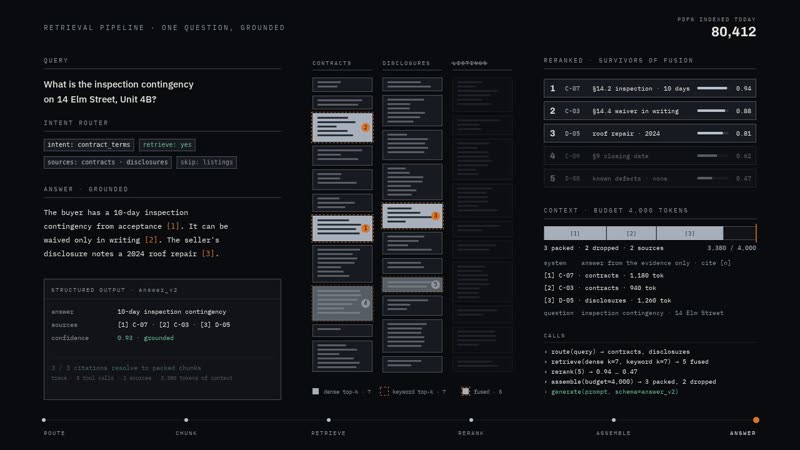
Intent routing, semantic chunking, hybrid dense and keyword retrieval with reranking, context-optimised prompts, cited answers.
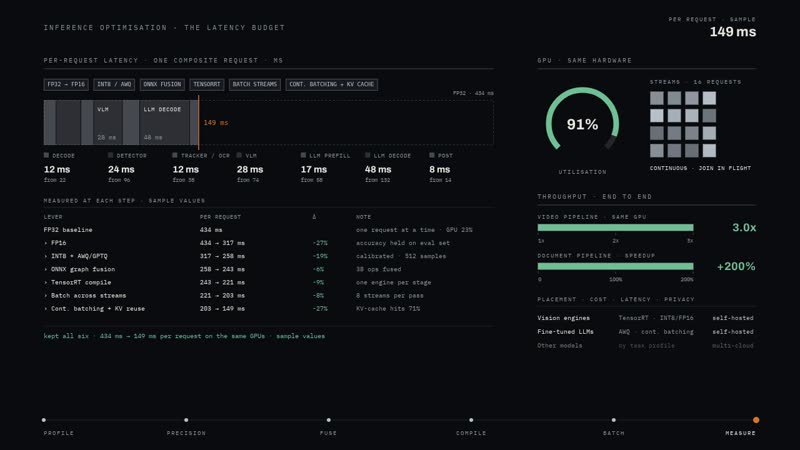
Precision, fusion, compilation and batching, applied one lever at a time and measured after each.
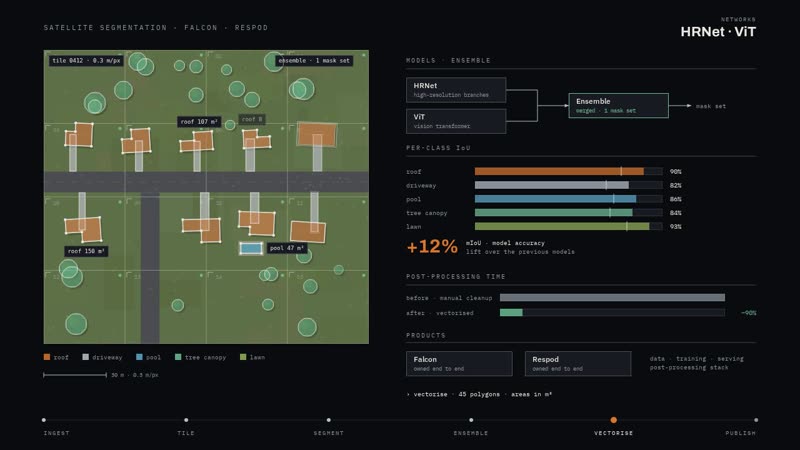
HRNet and Vision Transformer segmentation of property features, owned end to end across two products, Falcon and Respod.
Multi-cloud and self-hosted — each model lands where its cost, latency, and data-privacy profile fits best.
The 200% pipeline speedup and 3× FPS came from stacking these — measured at every step, not guessed.
Right-sizing intelligence: RL post-training for reasoning, low-rank adaptation for the domain, and architecture surgery when off-the-shelf isn't fast enough.
Reconstructed player trajectories in 3D from monocular sports footage using deep video transformers and classical SLAM. Added temporal event summarization via transformer-based description generation.
A camera-driven interface that maps real-world body actions into virtual gameplay using pose estimation, latency-aware gesture recognition, and real-time control mapping.
An edge-deployable assistant with multi-modal recognition: speaker ID, facial login, offline speech-to-text, and contextual response generation — all running on-device.
Open to conversations about AI/ML engineering, applied research, and hard problems in LLMs, VLMs, and computer vision.