Home/Work/Real-time sports analytics engine
Case study · Streamingo AI · Sports media and analytics · 2022–24
Real-time sports analytics engine
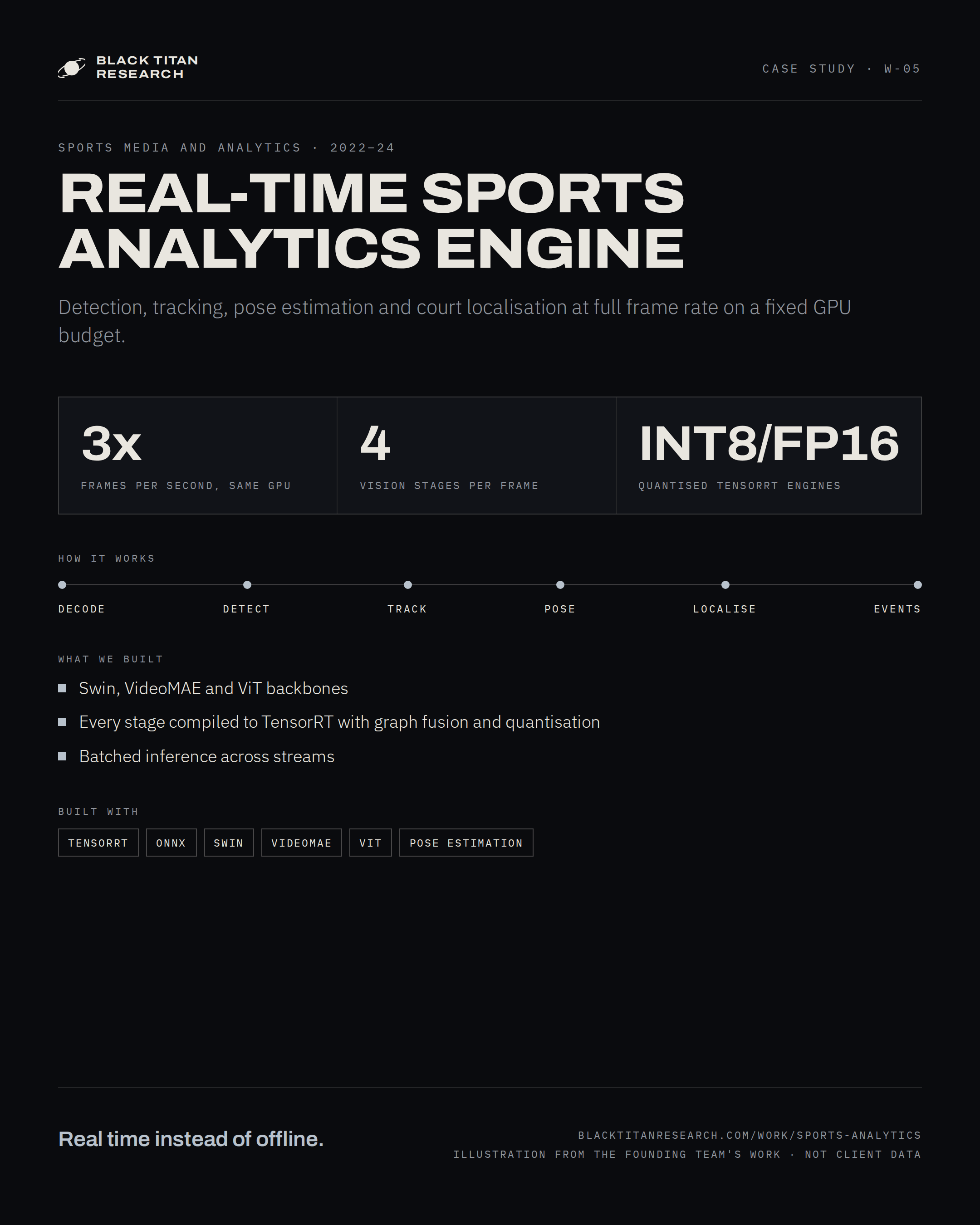
A live video pipeline combining object detection, multi-object tracking, pose estimation and court localisation, built on Swin, VideoMAE and ViT backbones, then optimised with TensorRT and ONNX to deliver 3x the frame rate for real-time analysis.
- EmployerStreamingo AI
- RoleDeep learning engineer
- Period2022 – 2024
- SectorSports media and analytics
§ 01 — Problem
Frame-accurate sports analytics needs detection, multi-object tracking, pose estimation and court localisation running together at full frame rate, on a fixed GPU budget. Each stage is a heavy vision model, and all four share the same GPU. Run one after another at native precision, the pipeline falls behind the video and analysis becomes an offline job.
The requirement was a single pipeline that keeps every stage in step with the incoming frames, across several streams at once, on the hardware already in place.
§ 02 — Architecture
Four stages, one GPU.
Detection, tracking, pose and court localisation run as TensorRT engines on one GPU, batched across streams.
§ 03 — How it works
One frame, four stages.
The animation follows live frames through decode, detection, tracking, pose, court localisation and events, with the per-stage latency and the frame-rate gain.
Diagrams and films on this page are illustrations of the system's architecture and behaviour, drawn from my work at Streamingo AI. They are not screenshots or recordings of production systems, which remain confidential.
§ 04 — Approach
Models
- Object detection and multi-object tracking for players and ball, with identities held across frames.
- Pose estimation for each tracked player, and court localisation to place every position on the court.
- Swin, VideoMAE and ViT backbones across the four stages.
- Related work in the same role: temporal event-understanding systems with Swin, VideoMAE, MVD, ViT and BEiT; zero-shot and few-shot classification with CLIP, Detic and Prototypical Networks for rapid scaling to unseen classes.
Inference
- Every stage exported through ONNX and compiled into a TensorRT engine.
- Graph fusion inside each engine.
- INT8/FP16 quantisation, chosen per engine.
- Batched inference across streams, so several feeds share one GPU at full frame rate.
§ 05 — Impact
3x the frames per second on identical hardware, which moved analysis from offline processing to true real-time.
What generalises: the frame-rate gain came from the whole chain, so every stage was compiled; precision was set per engine between INT8 and FP16; and batching across streams filled the GPU time that a single stream left idle.