Home/Work/Document intelligence platform
Case study · Real Brokerage · Real estate · 2024–26
Document intelligence platform
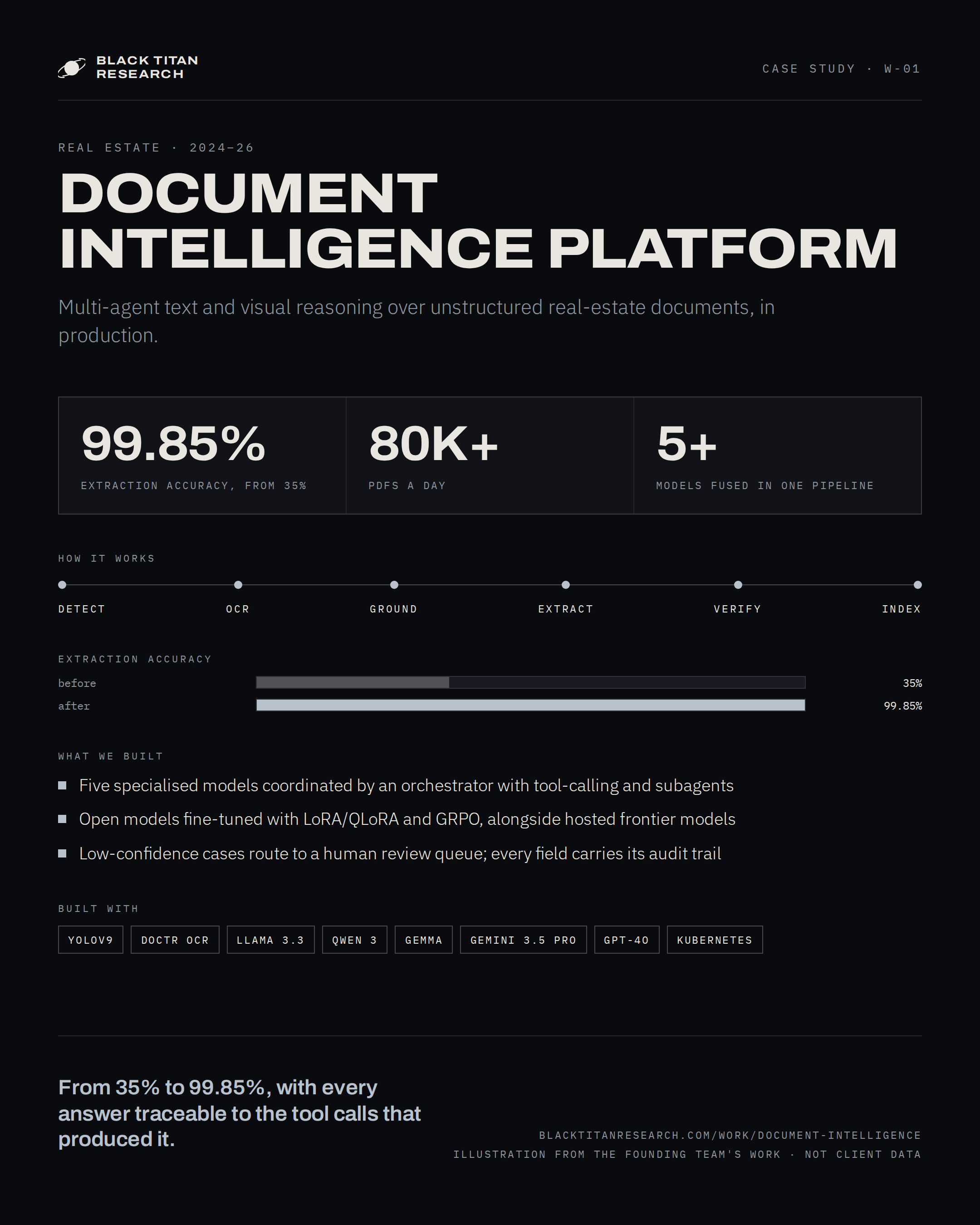
An enterprise platform that reads unstructured real-estate documents with multi-agent text and visual reasoning, in production at more than 80,000 PDFs a day.
- EmployerReal Brokerage
- RoleLead · team of eight
- Period2024 – 2026
- SectorReal estate brokerage
§ 01 — Problem
Real-estate transactions hinge on dense, wildly inconsistent documents: purchase agreements, disclosures, addenda, scanned signatures, photographed pages. Manual review was slow, error-prone, and impossible to scale with the brokerage's growth. Automated extraction stood at 35% accuracy, which is worse than useless because every result still had to be checked by hand.
The requirement was not a demo that reads one clean PDF. It was a system that reads every document the business receives, says how sure it is, and leaves an audit trail a compliance team can follow.
§ 02 — Architecture
Five models, one pipeline.
Review is decomposed into cooperating agents over specialised models, coordinated through tool-calling and subagents.
§ 03 — How it works
One document, end to end.
The animation follows a single purchase agreement through detection, extraction, grounding, reasoning, verification and indexing.
Diagrams and films on this page are illustrations of the system's architecture and behaviour, drawn from my work at Real Brokerage. They are not screenshots or recordings of production systems, which remain confidential.
§ 04 — Approach
Modelling
- Review decomposed into cooperating agents over five specialised models: object detection for layout, OCR, a vision-language model for layout and visual grounding, reasoning LLMs, and embedding models.
- Open models (LLaMA 3.3, Qwen, Gemma) fine-tuned on the real-estate domain with LoRA/QLoRA, then post-trained with GRPO-based reinforcement learning to build reasoning into the extraction task.
- Hosted frontier models (Gemini 3.5 Pro, GPT-4o) used alongside, chosen per task by cost, latency and accuracy.
- Structured, schema-bound output with per-field confidence and a full tool-call audit trail.
Deployment
- Microservices on Kubernetes across AWS and GCP.
- GPU-backed inference with continuous batching; self-hosted GPUs serve the fine-tuned open models.
- Graph optimisation, batched inference and quantisation delivered a 200% pipeline speedup.
- Human checkpoint: low-confidence extractions route to a review queue rather than silently passing.
§ 05 — Impact
Extraction accuracy rose from 35% to 99.85% in production. The platform processes more than 80,000 PDFs every day, with every extraction traceable to the tool calls that produced it.
What generalises: decomposition into narrow agents beats one large prompt; fine-tuned compact models beat hosted APIs on a narrow task once the evaluation exists to prove it; and a human queue for the hard 0.15% is what makes the other 99.85% trustworthy.